
Training, practice, progress in the art of avoiding traps
The quality of relationships is a fundamental pillar of a professional and personal life. Poor relationship quality is one of the pitfalls to be avoided if you want to keep your balance.
As a specialist in Karpman's Triangle, Training is Art can help you develop the skills you need to meet this noble challenge.
About
Training is art
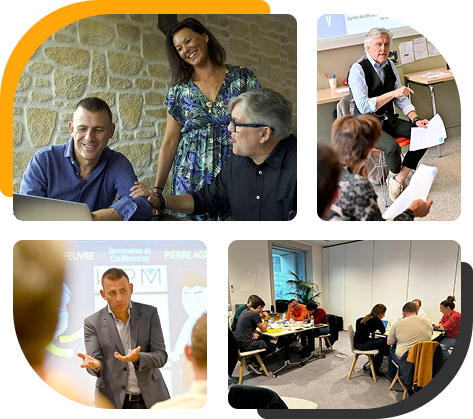
Training is Art is first and foremost a place of study, learning and training.
Practice and experimentation are at the heart of our teaching methods. When the art of training meets the desire to learn, the knowledge and skills acquired are unforgettable.
%
Customer satisfaction
%
Recommendation rate
Number of people trained
Our 2 key themes
Training is Art focuses its expertise on two emblematic themes:
- The art of healthy relationships or, how to keep toxic relationships at bay with Karpman's Triangle.
- The art of systemic management, or how to manage an organization with the Systemic Resonance Model (SRM®).

Two programs
-
Discover the real Karpman Triangle
-
Avoiding the traps of bad faith and psychological games

A program
Integrate the Systemic Piloting Guide into your governance method

Upcoming training courses
Discover the real Karpman Triangle
Avoid the pitfalls of manipulation
Systemic management of organizations
Latest articles
& refléxions
No Results Found
The page you requested could not be found. Try refining your search, or use the navigation above to locate the post.
FAQ
What is Training is Art?
Training is Art is a training organization specializing in the art of healthy relationships and human dynamics.
We support professionals, managers and experts in the development of their interpersonal, communication and strategic skills.
Our approach is demanding, experiential and rooted in field practice.
What is Qualiopi certification?
Qualiopi certification is an official recognition issued by an independent certifying body. It attests to the quality of our pedagogical processes, the information provided to beneficiaries, learner follow-up and our continuous improvement approach.
It is compulsory in order to benefit from public or shared funding.
What training courses do you offer?
We offer dedicated training courses for professionals and individuals wishing to deepen their interpersonal skills, including the analysis of relationship dynamics, conflict management and advanced intervention tools.
Each training course defines clearly identified target skills, measurable operational objectives and targeted professional situations.
We offer customized inter-company and intra-company training courses.
How do I register?
A registration form is available for each program.
Fill it in and send it to Virginie Bouffay at virginie@training-is.art to set up a telephone meeting to ensure that the training program meets your needs. This is followed by a quotation, training agreement or contract, and a deposit invoice.
All registration requests can be made by email or telephone.
Your contact: Virginie Bouffay at virginie@training-is.art or 06 78 79 47 46
Are there any prerequisites?
Any prerequisites are indicated on each program sheet.
What are the rates and financing options?
Prices are specified on each training page. Possible financing arrangements include OPCOs or the employer, depending on the situation. Virginie Bouffay is available to help you with administrative formalities. Tel: 06 78 79 47 46.
Are your training courses eligible for the Compte Personnel de Formation (CPF)?
None of our training courses is eligible for the CPF.
Are training courses accessible to people with disabilities?
Virginie Bouffay is your disability advisor and is available to analyze the adaptation needs of your situation. If necessary, Agefiph Ile de France will be our point of support. A personalized welcome will be arranged.
Contact details: 06 78 79 47 46 or virginie@training-is.art
How can I consult the internal regulations?
These rules and regulations apply to all learners taking part in a training course organized by us, for the duration of the course. The rules and regulations can be downloaded here: link and will be available on your extranet.
How can I access logistical, pedagogical and follow-up information?
Each learner will receive a link to an extranet. On logging on, all information will be available (rules and regulations, training times and location, full program, pedagogical documents, welcome booklet for inter-company training, follow-up documents, on-the-spot satisfaction questionnaire).
Proof of attendance and follow-up (attendance sheets and training certificates) will be sent to the client in the case of customized and individual training, or made available on the extranet in the case of inter-company training.
How are skills assessed?
Skills are assessed by means of role-playing and practical exercises. At the end of the course, participants are given a quiz to assess what they have learned.
Your skills will be assessed, graded and recorded on your certificate.
-
Acquired: > 75
-
Between 50% and 74% in the process of acquisition
-
Not acquired: < 50%
Is a certificate issued?
Yes, an end-of-training certificate is issued, mentioning the title, duration and skills worked on + end-of-training test score.
How do you measure learner satisfaction?
With the help of an on-the-spot satisfaction questionnaire, we collect on-the-spot satisfaction rates, recommendation rates and qualitative feedback in order to continuously improve our programs and processes.
What happens after the course?
Depending on the system, individual debriefing, additional resources or a personalized action plan may be offered.
What if I have a complaint?
You can do this orally directly to your trainer.
You can send an email to Virginie Bouffay, our Quality Manager.
Contact details: 06 78 79 47 46 or virginie@training-is.art
The team will be happy to listen to you and find an appropriate solution to your complaint. This follow-up will give us the opportunity to transfer it to our continuous improvement process.